01 · Learn
Build the mental model
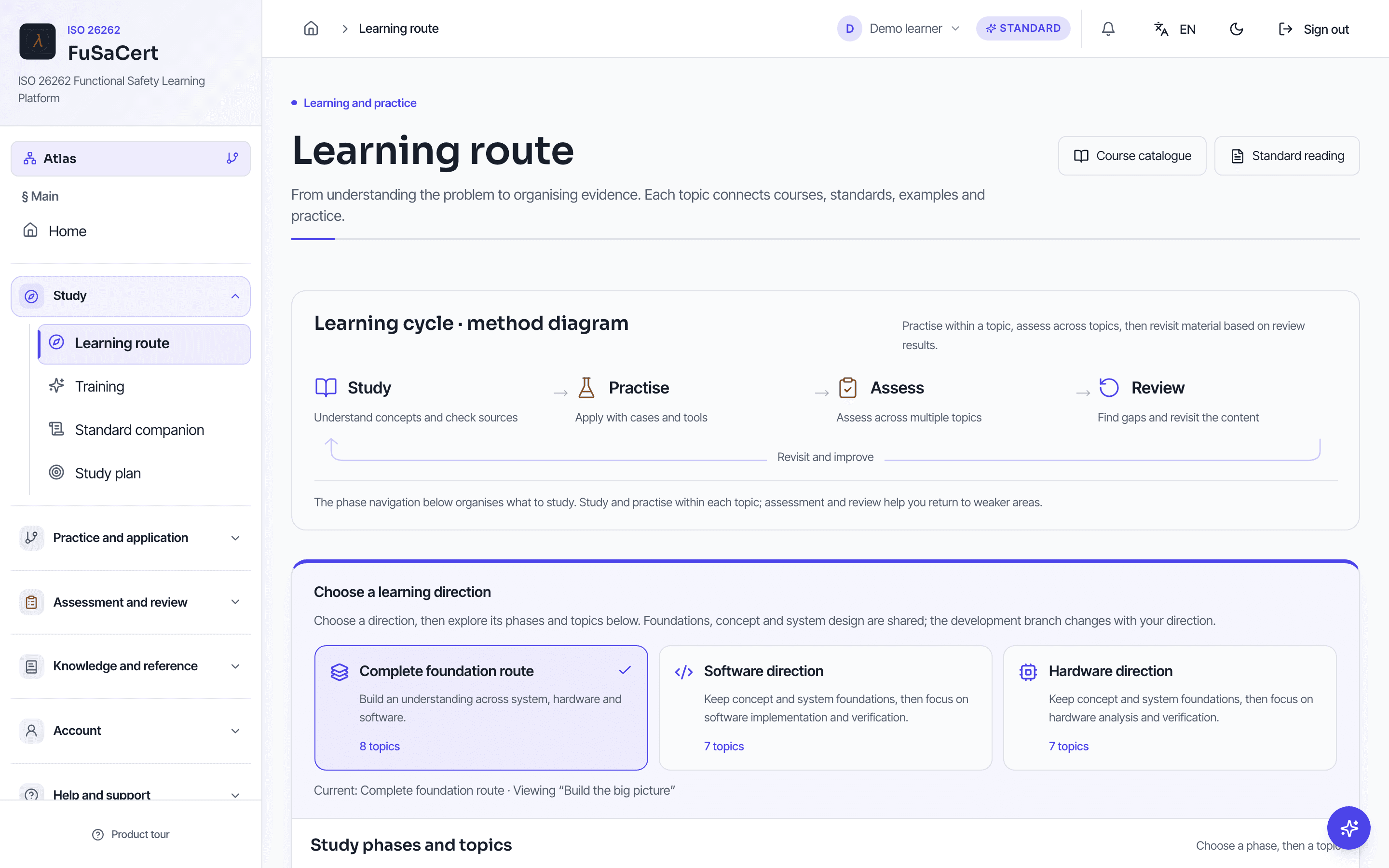
Follow the atlas into courses and the standard companion to understand concepts and their relationships.
Functional Safety · Learn · Prepare
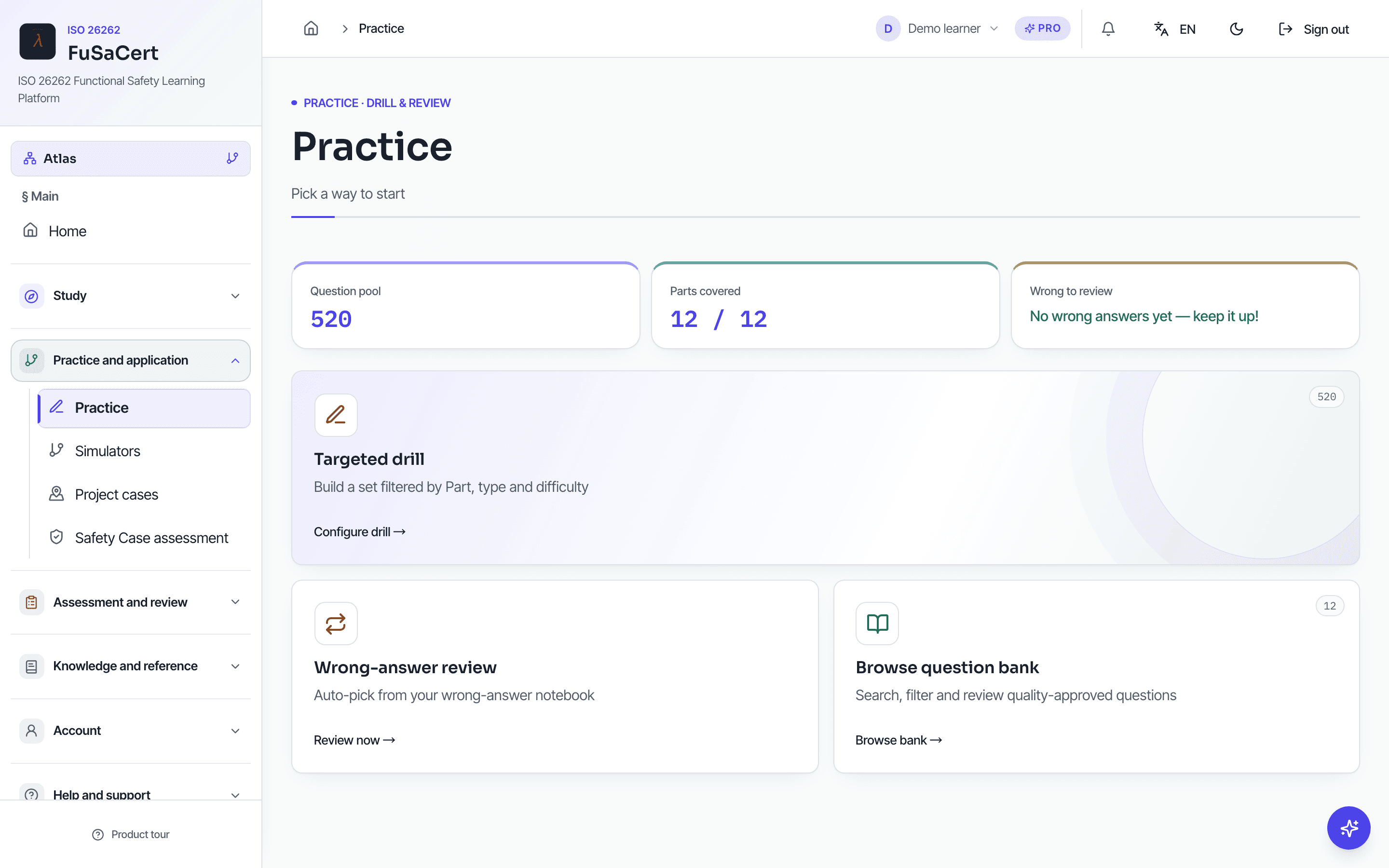
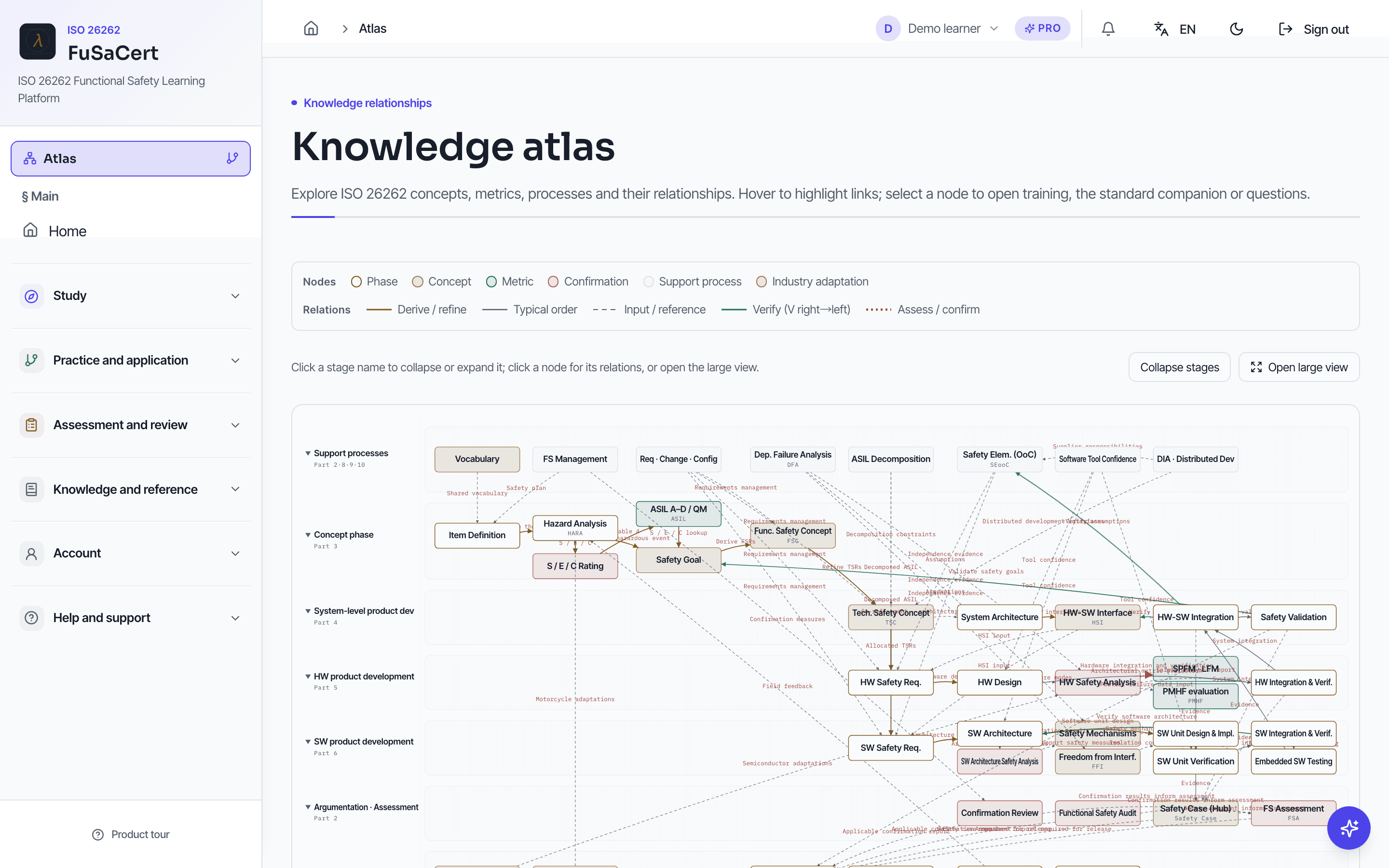
Quality-approved practice questions, 158 bilingual terms, overviews and selected reading for all 12 Parts, 10 safety-analysis workspaces, and a V-model knowledge graph connecting Parts 3–11.
Free plan available now · No credit card
A V-model view of concepts, work products and verification activities
Built for practitioners
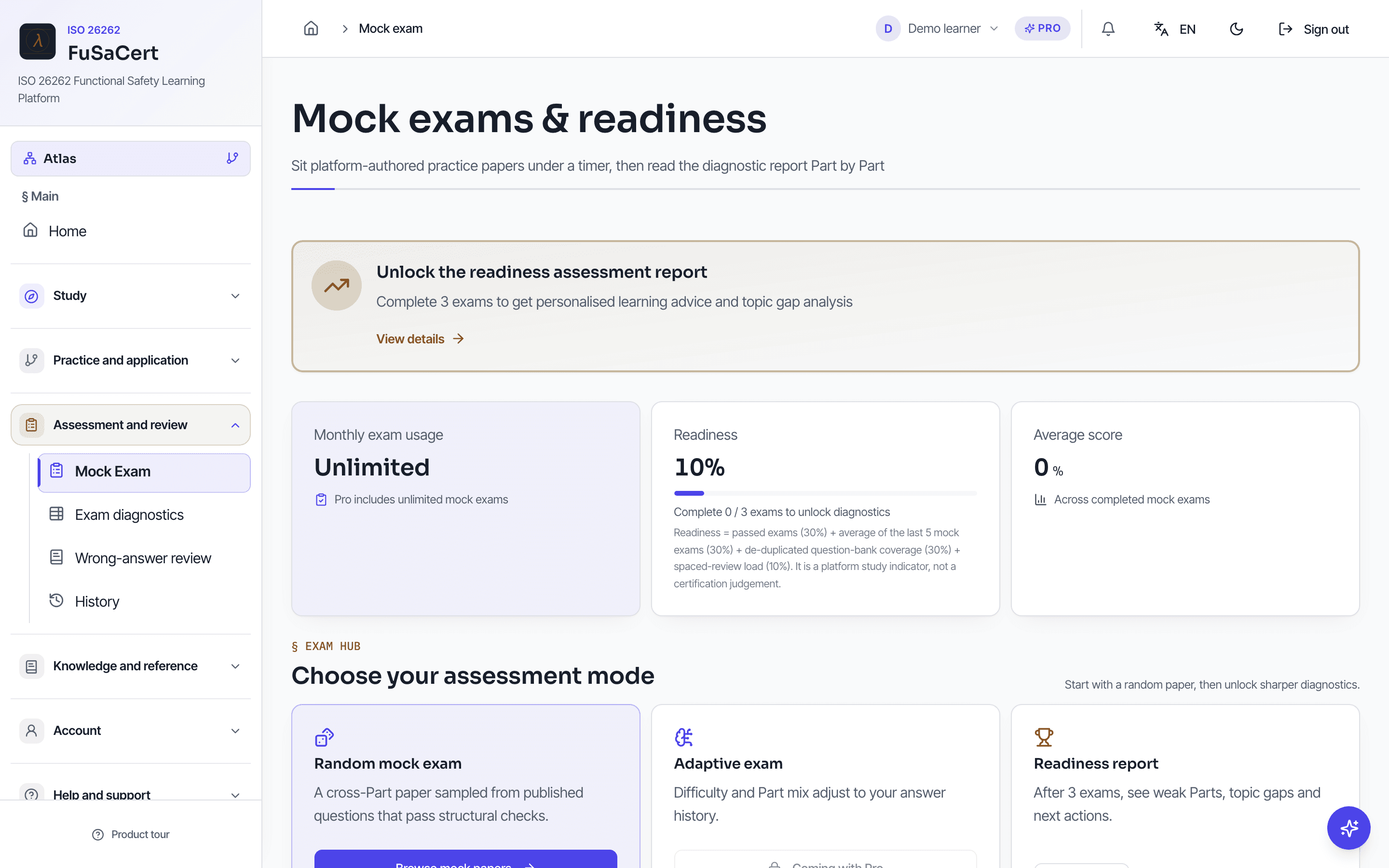
Single-choice, multi-choice and scenario questions are published according to review status. Platform-authored timed mocks provide Part-by-Part score diagnostics.
Complete capability loop
Move from the atlas, selected reading and practice questions into analysis workspaces and work products, with available sources and review status shown in the content.
Follow the atlas into courses and the standard companion to understand concepts and their relationships.
Targeted drills, mistake review, and mock reports identify weak Parts together.
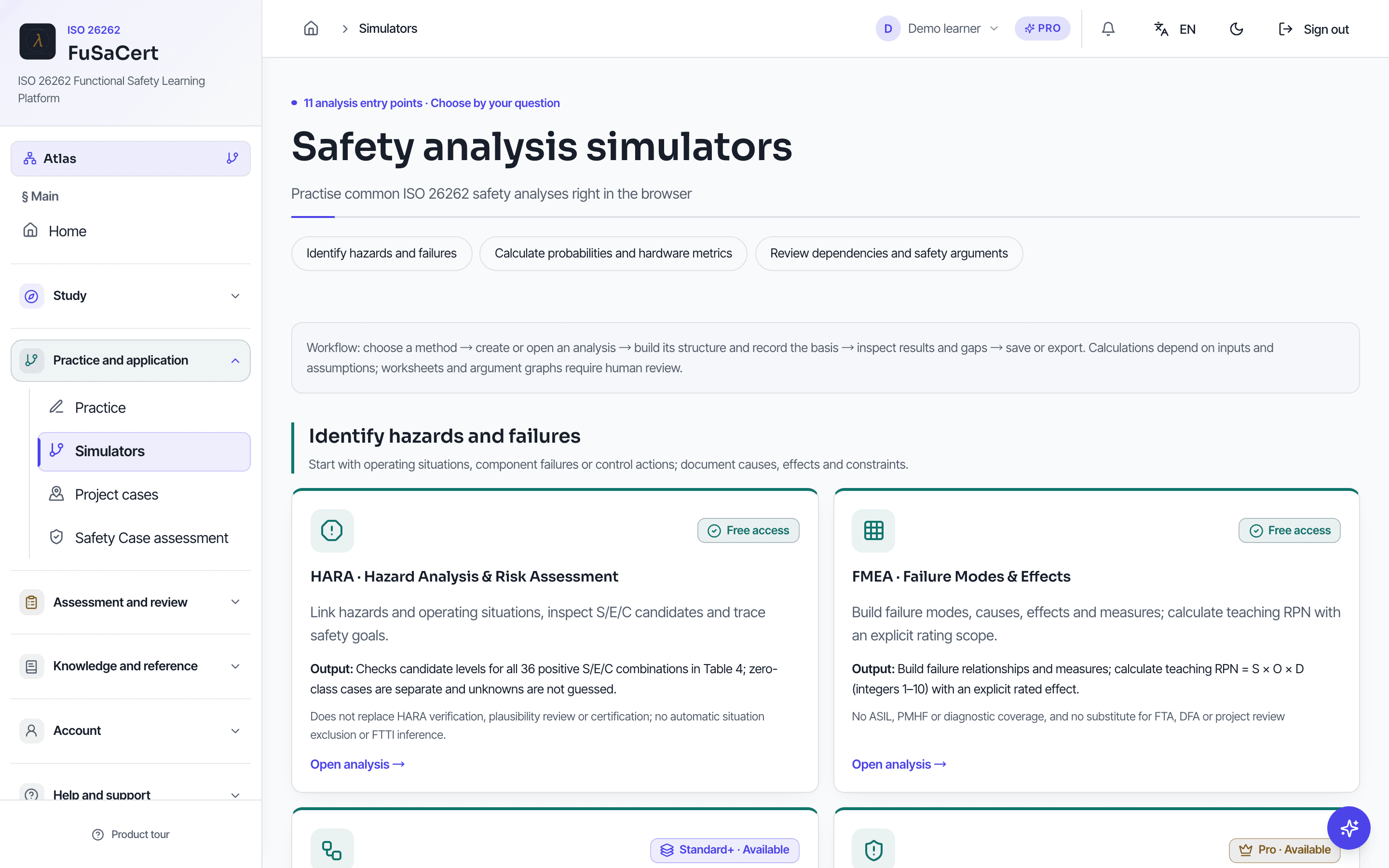
Practise engineering judgement in HARA, FMEA, FMEDA, and FTA workspaces.
Connect analysis results to templates, clause references, and reusable evidence structures.
What we added
The atlas places included concepts, work products and verification activities along a V-model so you can inspect their positions and links. Engineering decisions still require the official standard.
Onboarding, streak, volume, accuracy, part coverage, mastered mistakes, safety analysis and mock scores — 8 categories, 21 badges, turning exam prep into visible progress.
Content shows available Part/clause references and verification status. Course references link to the relevant Part companion for further reading.
Try the Free plan first. If you need more practice or tools, paid access is a one-time 30-day purchase with no auto-renewal.
Pricing
Try the Free plan first, then choose 30-day access if you need more. Free quotas reset by UTC calendar month; Standard and Pro quotas reset with each 30-day plan period. Every plan includes the glossary, published knowledge entries, progress tracking and a bilingual interface; engineering calculators are open to signed-in users, while saving and exports remain subject to plan limits.
Try HARA analysis and engineering calculators first, then decide whether you need more practice and analysis workbenches.
No credit card — register and start
For exam candidates practising daily with the published standard companion.
One-time 30-day access · no auto-renewal
For engineers who need AI answers, exports, the safety-case workspace and every project walkthrough with its evidence set.
One-time 30-day access · no auto-renewal
The simulators practise methods: FMEA computes RPN, FTA analyzes failure combinations and minimal cut sets, HARA derives ASIL from Part 3 Table 4, FMEDA computes SPFM/LFM, RBD estimates a two-level topology and the Markov teaching model computes transient state probabilities. GSN, HAZOP, DFA and STPA currently draft structured records. Results are not compliance conclusions or certification evidence.
FAQ
The 2018 edition has 12 Parts. Parts 1–9 cover vocabulary, safety management, the concept phase, systems, hardware and software development, production, operation and supporting processes. Part 10 provides guidance, Part 11 addresses semiconductors and Part 12 adapts the standard for motorcycles. The companion organizes overviews and published selections by these 12 Parts.
The learner-visible pool contains quality-reviewed original, standards-based and scenario questions. Each published item has a type, difficulty, explanation and source/review status; rows still marked revise or quarantine are withheld from practice and exams.
Through HARA — Hazard Analysis and Risk Assessment. Rate Severity, Exposure and Controllability for each hazardous event; the combination yields QM or ASIL A through D. The HARA simulator lets you run this end to end.
FMEA traces failure modes to their effects; FTA traces a top event to possible cause combinations. FMEDA classifies hardware failures to support architectural metrics. This platform's FMEDA worksheet calculates SPFM and LFM; a full PMHF analysis must be completed separately.
A knowledge base is a list of entries; a graph is a network. This atlas selects core ISO 26262:2018 concepts, work products and activities, organizes them along a V model, and labels five relation types: derivation, typical order, input, verification and assessment. It is a learning guide, not a complete inventory of standard clauses or work products. Select a node to see its links and source.
Yes. The interface, glossary, knowledge articles and question explanations are available in Chinese and English. The standard companion distinguishes Part overviews, reading notes and authorized excerpts; excerpt languages follow their individual sources.
Yes. The current Free plan has no charge and includes 20 practice questions, one mock exam and 3 AI answers per UTC calendar month, plus the glossary, HARA workspace and engineering calculators. Standard and Pro limits reset with each 30-day plan period.
You can provision individual Standard or Pro accounts for team members; centralized seats and team management are not available yet. After payment, we provide an order/payment receipt, not a promised mainland China VAT invoice. For business purchases or invoice requirements, contact us via the footer email before paying.
Free plan available now · No credit card